The Workers’ Comp Settlement Sounded Fair Until Someone Added Up What It Left Out
Here’s the mistake I see most often, and it happens before anyone calls a lawyer. A worker gets hurt on the job — a welder at a Mobile shipyard, a driver hauling materials through Baldwin County, a plant operator who catches a piece of equipment the wrong way — and within a week or two, somebody from the insurance company calls. They’re polite. They explain that workers’ compensation will cover the medical bills and some lost wages. They might even mention a settlement figure. And the worker, already stressed, already worried about being seen as a troublemaker, thinks: that sounds reasonable. I don’t want to make this into a big thing.
That’s the moment I wish I could step in. Not to stir anything up. Just to ask one question: did anyone tell you whether a third party might be responsible for what happened to you?
Workers’ Comp vs. a Personal Injury Claim: They’re Not the Same Road
This is the distinction that gets buried fastest, and it costs people the most.
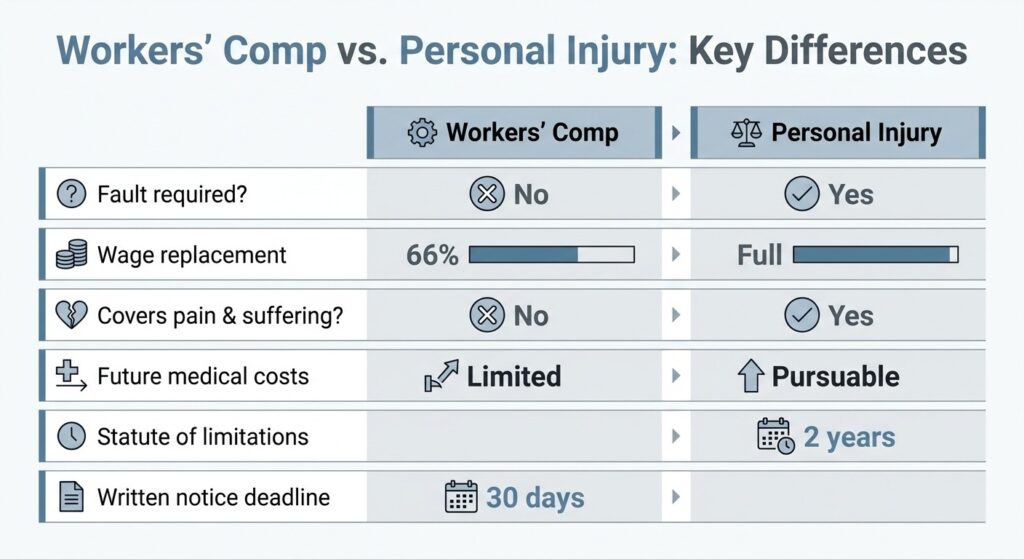
| Workers’ Compensation | Personal Injury Claim | |
|---|---|---|
| Fault required? | No — no-fault system | Yes — must prove negligence |
| Filed against | Employer’s insurance carrier | Negligent third party |
| Covers pain & suffering? | No | Yes |
| Wage replacement | Typically ~66% for limited period | Full wage loss, including future |
| Future medical costs | Limited | Pursuable |
| Right to sue employer? | Generally waived | Not applicable (third party only) |
Workers’ compensation is genuinely useful. Under Alabama law, workers’ comp pays two-thirds — 66% — of an employee’s average weekly wage, calculated from earnings over the 52 weeks before the accident, subject to state-mandated minimums and maximums set by the Alabama Department of Labor. That tradeoff exists for a reason. But it has a ceiling. Your employer carries it, you file a claim, and in exchange for benefits — medical care, a portion of your lost wages — you generally give up the right to sue your employer directly. That tradeoff exists for a reason. But it has a ceiling.
A personal injury claim is different. It requires proving that someone was negligent — that their carelessness caused your injury. Against your employer, that path is mostly closed by the workers’ comp system. But against a third party? That door can still be wide open.
Think about what that means in practice:
- A welder gets hurt because a subcontractor’s crew left equipment in an unsafe position
- A delivery driver gets hit by another vehicle while making a work stop
- A plant worker is injured by a defective piece of machinery manufactured by a company unrelated to their employer
In each of those situations, pursuing both claims simultaneously is often possible — workers’ comp from the employer’s insurer, and a separate personal injury claim against the negligent third party. Most injured workers I talk to have never heard this explained clearly.
The practical difference is significant. Workers’ comp might cover your surgery and replace 66% of your wages for a period of time. A personal injury claim can pursue full wage loss, future medical expenses, and damages for pain, suffering, and diminished quality of life. If you settle workers’ comp without knowing a third-party claim exists, you may be leaving the larger recovery on the table permanently.
What to Do in the Days Right After the Accident
The first 72 hours matter more than most people realize — not because of some legal technicality, but because evidence disappears, memories blur, and insurance adjusters move fast.
Step 1: Report in writing. Tell your employer about the injury even if you already told your supervisor verbally. Get it documented.
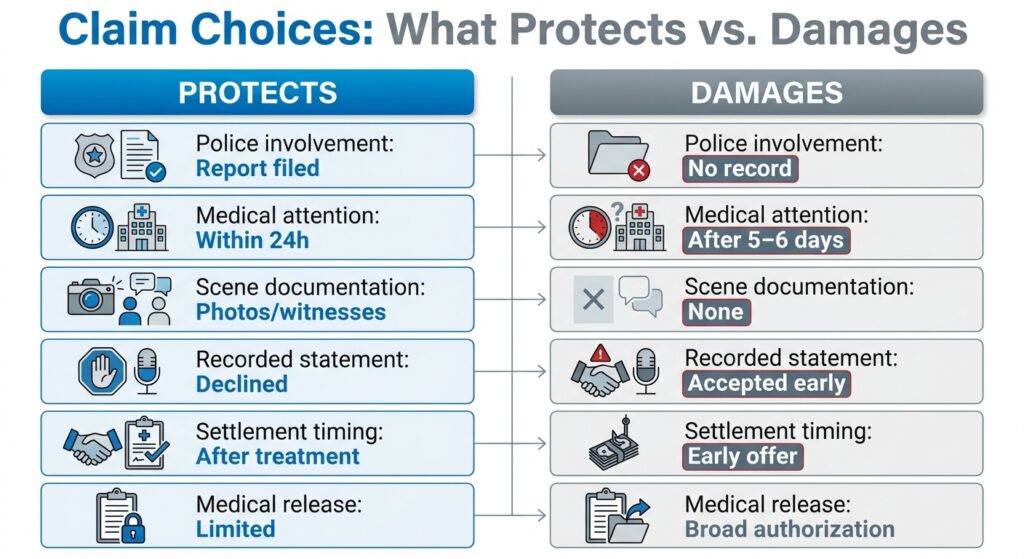
Step 2: Get medical attention immediately. A gap between the accident and your first medical visit becomes a weapon in the hands of an insurance adjuster trying to minimize your claim.
Step 3: Preserve everything you can. Photos of the scene. Names of witnesses. A written account of what happened while it’s fresh. Any incident reports or police reports — get copies.
Proper documentation from the start — reporting the injury, seeking care, and preserving evidence — is what makes a third-party claim viable later. These details feel small when you’re in pain and just trying to get through the day. They become the foundation of everything that follows.
One deadline that catches people off guard: Under Alabama Code Section 6-2-38(l), any lawsuit for injury to the person must be filed within two years — and the clock starts running on the date of the injury, not the date you hired a lawyer or filed a workers’ comp claim. Waiting even a few weeks to understand your options can close certain doors permanently. A quick consultation with a lawyer costs you nothing but an hour. Missing a deadline costs you the case.
How to Evaluate a Personal Injury Lawyer and Law Firm
Not every lawyer who handles workplace accidents is the right fit for your situation.
A workers’ compensation attorney and a personal injury lawyer ma handle fundamentally different legal processes. Some firms do both well. Others specialize in one. Knowing the difference before you walk in the door saves time and frustration.
Questions worth asking in any initial consultation:
- Have you handled cases where a subcontractor, equipment manufacturer, or other outside party was responsible for a workplace injury?
- How did those cases resolve?
- What percentage do you take on contingency, and does that change if the case goes to trial?
- Who will actually be handling my case day-to-day?
- How often will I receive updates, and through what channel?
You’re not being difficult by asking these. You’re doing exactly what you’d do before hiring anyone for something important.
What you should expect from competent legal representation: regular updates, clear explanations of where your case stands, active negotiation on your behalf, evidence gathering, and someone who’s actually thinking about your future medical needs — not just the immediate bills. What good representation looks like in practice is straightforward: you feel informed, not managed.
If a firm assigns you a case number and you never hear from anyone, that’s a problem. The thing injured workers complain about most when they feel let down isn’t the outcome — it’s the silence.
The Objections I Hear Every Time
“I don’t want to sue my company. They’ve been good to me.”
I hear this constantly, and I understand it. Work is identity. You’ve been with the same crew for years. You don’t want to blow that up over an accident.
But workers’ compensation claims don’t sue your employer. They’re filed against the employer’s insurance carrier. Your employer pays premiums specifically so this system exists. Using it isn’t betrayal — it’s exactly what it was designed for. And if a third-party claim exists, you’re not suing your employer at all. You’re pursuing a separate party whose negligence hurt you. That’s not disloyalty. That’s accountability directed at the right place.
“The settlement offer seems fair. Why complicate it?”
Because fair-seeming and actually fair are two different things.
An adjuster’s job is to close claims efficiently, not to maximize your recovery. They know the policy limits. They know what your case might be worth at trial. You don’t — yet. A settlement that covers your current medical bills might leave you completely exposed if your injury requires future surgery or limits your ability to work in your trade. Once you sign, that’s typically the end of it.
“I can’t afford a lawyer.”
Contingency fees mean you don’t pay unless you recover. A client consultation costs nothing. The risk of not talking to someone is far higher than the risk of making a phone call.
What the Process Actually Looks Like
Here’s roughly what happens once you connect with a law firm for an initial consultation.
Phase 1 — Case Review. The firm reviews the facts of your accident, your medical records, and any incident documentation. They identify whether your situation involves only workers’ compensation or whether a third-party personal injury claim also exists.
Phase 2 — Investigation. If both paths are open, the investigation begins: gathering evidence, identifying all liable parties, understanding the insurance policy limits involved. That last piece matters more than people expect. Knowing what coverage exists shapes the entire negotiation strategy. A case with a clear liability picture and adequate insurance coverage moves differently than one where coverage is disputed or limited.
Phase 3 — Negotiation. Settlement negotiations happen before most cases ever reach a courtroom. If the other side makes a reasonable offer that accounts for your full damages — current and future medical costs, lost wages, pain and suffering — your attorney will walk you through it honestly. If the offer is low, they push back.
One thing that never changes regardless of phase: you make the final call on any settlement. Always.
Where to Start
If you’re reading this on your phone at 11pm because something happened at work and you’re not sure what to do next, here’s the short version:
Report the injury in writing. Get medical care documented. Talk to a lawyer before you sign anything from an insurance company.
You don’t need to have it all figured out before you make that call. The consultation exists precisely so someone with experience can look at your specific situation and tell you what you’re actually dealing with. That’s not starting trouble. That’s making sure you understand what you’re agreeing to before you agree to it.
Getting a second opinion on something this important isn’t greed. It isn’t disloyalty. It’s the same practical self-respect you’d apply to any major decision that affects your health, your income, and your family’s stability.
You’ve earned that much.